Armley
A Woman of SubstanceArmley is a West Riding settlement whose streets and workplaces mark a turning point in Emma Harte’s life: it offers her a place to live and a means of earning a living, but also brings her close to the retail landscape that awakens her ambitions as a future businesswoman. The town is presented both as a practical refuge during a difficult pregnancy and as a place where employment, domestic arrangements, and commercial possibility meet.
Setting and regional context
Armley appears in the novel as a spread-out settlement with a main shopping thoroughfare, substantial homes, parks, and textile employment. Its position near Leeds gives it a measure of connection to the larger city, but Blackie O’Neill presents it as a place where Emma could find much of what she needed without having to go into Leeds. The contrast matters: Armley is neither an isolated village nor simply an extension of the city. It has its own workplaces, residential streets, and commercial life.
The wider West Riding setting is also defined by the resources that sustained wool manufacturing. The account of the region describes the Pennines’ hard millstone grit, the coarse grass and oats that support short-haired sheep, and streams supplied by rain-bearing winds. Unlike limestone water, the soft water of these streams is kind to fibres. Wool and soft water together made the West Riding especially suited to cloth production. Armley’s mills belong to this regional economy, in which local industry depends on the interaction of landscape, raw materials, and manufacturing.
Emma’s arrival and domestic prospects
In January 1906, Blackie brings Emma by tram to Armley on a bitter-cold Sunday. She is reluctant to move. She has recently learned tailoring at Kallinski’s tailoring workshop and does not want to exchange that work for weaving at Thompson’s mill. She also has a place at Mrs Daniel’s boarding house, where she has use of the kitchen. Her resistance is not simply a rejection of Armley; it reflects her dislike of being uprooted and her concern that changing jobs will mean abandoning a trade she has just begun to master.
Blackie’s proposal answers those practical objections with a new arrangement. Emma can live with Laura Spencer, whose recently widowed mother has died and who needs a paying guest to share the household expenses. Laura’s house is small but well kept, and Laura can help Emma obtain work at the mill where she is employed. It is about a ten-minute walk from the house, a substantial improvement on Emma’s daily walk of roughly three-quarters of an hour each way to Kallinski’s. The Kallinski family is willing to take Emma back after the baby is born, so the move need not mean a permanent severing of those ties.
Blackie also points to Armley’s practical services. St Mary’s Hospital is nearby, and he considers it a possible place for the birth. Armley Park and its Sunday brass band offer a place for recreation; shops and pleasant streets would make ordinary errands possible locally. His pitch treats the town as a network of provisions for Emma’s changing circumstances: somewhere to live, a shorter journey to work, medical care, and access to daily necessities.
Town Street and the idea of a shop
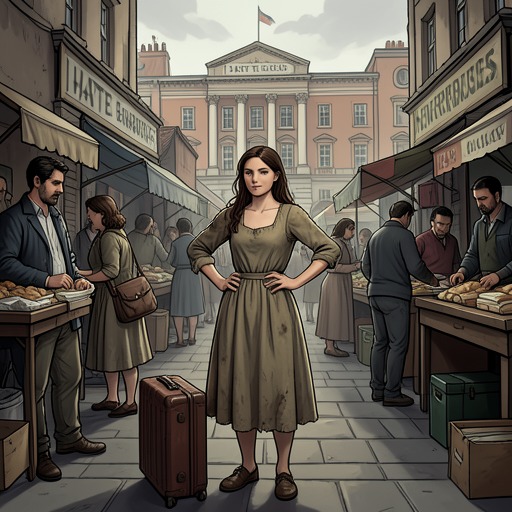
Armley’s shops alter Emma’s response to the move. Blackie describes the settlement as larger and more varied than she had assumed, with mansions occupied by millowners and other affluent residents as well as shops on Town Street serving the carriage trade. He lists food retailers, a chemist, a newsagent, a draper, a haberdasher, a shoe shop, and a ladies’ dress establishment. The variety suggests a commercial district serving customers beyond the immediate working population.
When Blackie leads her past the shops, Emma’s sadness gives way to close attention. She recognizes Town Street as a promising shopping area and reasons that rents may be lower there than in Leeds. Before reaching Laura’s house, she is already imagining a first shop and the merchandise it might carry. She intends to appeal to the carriage trade, identifying affluent customers as the source of greater returns. Armley thus becomes more than the destination of a move arranged by Blackie: its retail geography gives Emma a specific setting in which to imagine economic independence.
A small triangular plot called Charley Cake Park adds another local marker to their walk, while the Towers and its tree-lined drive indicate the presence of wealthy residents. These features make social difference visible within the same settlement. Emma’s attention, however, settles most intensely on the shops. The route through Armley turns an apparent compromise in housing and employment into the beginning of a commercial plan.
Work, public space, and conflict
Emma starts at Thompson’s mill on the Monday after her move. She finds a disciplined, tightly controlled workplace, in marked contrast with the camaraderie she had experienced at Abraham Kallinski’s small factory. Laura teaches her patiently, but weaving is difficult, and a loom trap—caused when many threads break—can take hours to repair and force a weaver to make up lost time. Emma perseveres and masters the craft within a month. Her success shows the practical side of the move: Armley supplies work that she needs, even when the conditions and the work itself are not to her liking.
The town’s park also serves as a proposed meeting place. David Kallinski asks Blackie to persuade Emma to take a Sunday off so that they can walk there and listen to the band. On the appointed sunny July afternoon, David arrives at Armley Park dressed for the occasion. The park’s formal entrance has iron gates bearing the city’s coat of arms, and its principal approach leads to a large fountain. An inscription records that William Gott of Armley House erected it to commemorate the sixtieth year of Queen Victoria’s reign, from 1837 to 1897. The park’s public amenities and memorial give it a civic character distinct from the mill and the commercial street.
Armley is not wholly protective. Later, Gerald Fairley refers to finding Emma living there and describes having tried to attack her. The recollection makes the location part of the history of her exposure to danger, rather than merely a safe new home. The same town that gives Emma a household and employment cannot insulate her from the conflicts that follow her from the past.
Narrative significance
Armley’s significance lies in the way its different spaces shape Emma’s choices. Laura’s house offers a workable domestic arrangement; Thompson’s mill provides income and demands new skills; the park represents public leisure and social life; and Town Street makes a future business imaginable. These are not interchangeable settings. Each answers a different need, and the route between them maps Emma’s passage from reluctant dependence on other people’s arrangements toward a more self-directed future.
The decisive change occurs when Emma sees the shops. What Blackie intends as persuasion to accept a move becomes, for her, an occasion to assess rents, customers, and the prospect of opening a store. Armley therefore functions as both a practical setting and a point of departure for her commercial imagination. Its mixed landscape of mills, respectable homes, civic spaces, and retail trade brings together the work she must do now and the independence she hopes to secure.